


Are Business Frameworks Just Corporate Jargon?
You’ve sat in meetings, read articles, or maybe watched a TED Talk where someone enthusiastically throws around terms like “SWOT analysis” or “Porter’s Five Forces.” You nod along, pretending you know what they’re talking about, while secretly wondering if these are just fancy words for common sense.
You’re not alone. Many ambitious professionals and new entrepreneurs feel like they’re missing the secret handbook to strategic thinking. But here’s the truth: business consulting frameworks are just strategic tools, not magic spells. They’re a way to organize your thinking and turn a complex problem into a clear, actionable plan.
The problem isn’t the frameworks themselves; it’s that they’re often taught in a way that’s boring and unrelatable. It’s like being handed a toolbox with no instructions.
This guide is your instruction manual. We’ll break down five essential business frameworks every owner should know, explain them in plain English, and—best of all—show you how to use AI to apply them to your business today.
1. The SWOT Analysis: Your Internal and External Reality Check

What it is: SWOT stands for Strengths, Weaknesses, Opportunities, and Threats. It’s the most fundamental tool for understanding your business and its competitive environment. Think of it as a four-quadrant map of your reality.
- Strengths (Internal): What does your business do well? (e.g., A strong brand, talented team, loyal customers).
- Weaknesses (Internal): Where are your internal vulnerabilities? (e.g., A slow website, outdated tech, small marketing budget).
- Opportunities (External): What are the favorable external conditions you can leverage? (e.g., A new market trend, a competitor’s failure, emerging technology).
- Threats (External): What are the external risks to your business? (e.g., A new competitor, economic downturn, changing regulations).
How to Use It: You can perform a SWOT analysis in an afternoon with your team. This framework is a simple, powerful way to get everyone on the same page and identify what to focus on.
AI Prompt Example: Don’t start from a blank page. Use AI to kickstart your thinking and generate a first draft based on what you already know.
“Act as a business strategist. Create a SWOT analysis for a new e-commerce startup that sells eco-friendly home goods. Base the analysis on the following assumptions: our brand is highly ethical, we have a small team, the market for sustainable products is growing, and large retailers are starting to enter the space.”
2. The 80/20 Rule: The Principle of Focused Effort
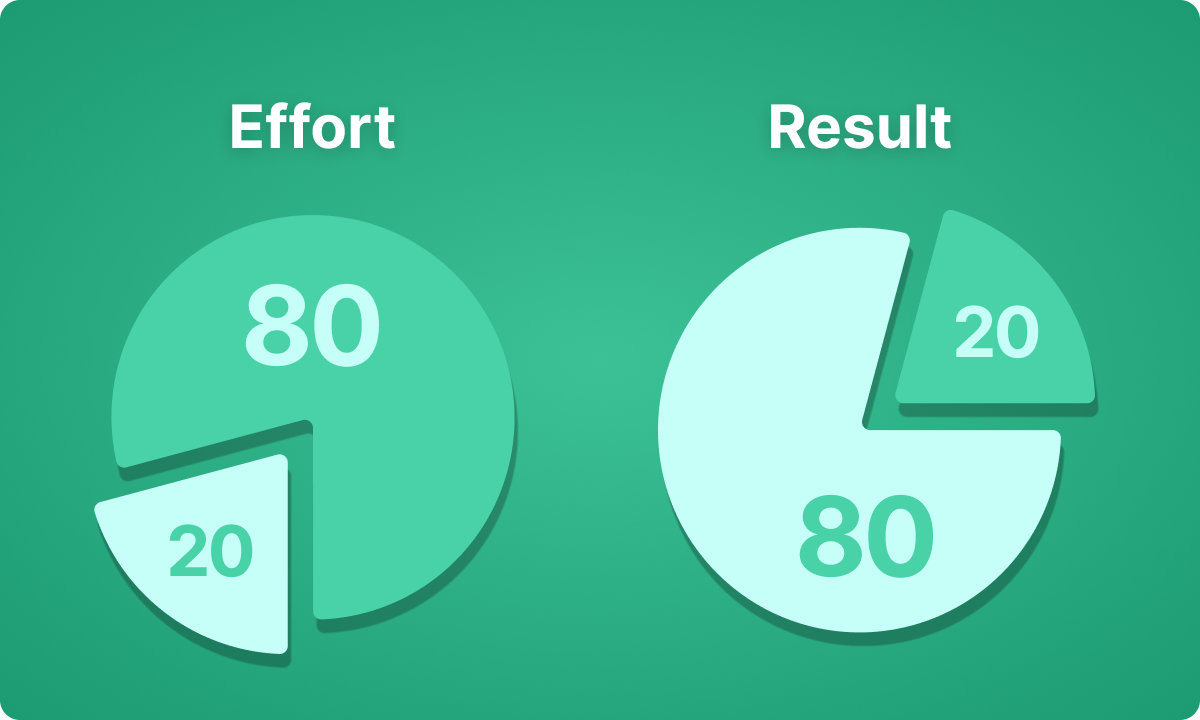
What it is: The Pareto Principle, or the 80/20 Rule, states that roughly 80% of your results come from just 20% of your efforts. In business, this could mean:
- 80% of your revenue comes from 20% of your customers.
- 80% of your headaches come from 20% of your tasks.
- 80% of your marketing results come from 20% of your channels.
How to Use It: The goal of the 80/20 Rule is not to be exact, but to focus your attention. This framework teaches you to identify the vital few inputs that generate the majority of your outputs. As a business owner, your most valuable asset is your time. This framework helps you spend it on what truly matters.
AI Prompt Example: Use AI to help you apply the 80/20 Rule to your business’s data or workflows.
“Act as an efficiency expert. Based on a list of my current business activities, identify the 20% of tasks that likely generate 80% of our revenue. Conversely, identify the 20% of tasks that consume the most time but provide the least value. Provide a bulleted list for each.”
3. PESTLE Analysis: Your Bird’s-Eye View of the Market
What it is: PESTLE stands for Political, Economic, Social, Technological, Legal, and Environmental. It’s a strategic framework used to analyze the external macro-environmental factors that can impact your business. While a SWOT analysis is your ground-level view, PESTLE is the view from 30,000 feet.
- Political: Government policy, political stability, tax laws.
- Economic: Interest rates, inflation, economic growth.
- Social: Cultural trends, demographics, consumer behavior.
- Technological: Automation, AI, new software.
- Legal: Employment laws, consumer protection, health and safety regulations.
- Environmental: Climate change, sustainability, ethical sourcing.
How to Use It: A PESTLE analysis helps you spot trends and prepare for future shifts in your industry. It’s an essential part of a business playbook and a key component of the business acquisition certification that every aspiring owner should master.
AI Prompt Example: Getting a handle on all these factors can be a lot. Let AI do the heavy lifting of gathering and organizing the information.
“Act as a market researcher. Perform a PESTLE analysis for a small restaurant chain looking to expand. Focus on recent trends and key factors for the U.S. food service industry. Provide a summary for each of the six PESTLE components.”
4. Porter’s Five Forces: Understanding Your Competition
What it is: Developed by Michael Porter, this framework helps you analyze the competitive intensity and attractiveness of an industry. It looks at five key forces that shape your profitability.
- Threat of New Entry: How easy is it for new competitors to enter the market?
- Threat of Substitutes: Can customers easily switch to a different product or service?
- Bargaining Power of Buyers: How much power do your customers have to drive prices down?
- Bargaining Power of Suppliers: How much power do your suppliers have to raise prices?
- Competitive Rivalry: How intense is the competition among existing players?
How to Use It: By understanding these forces, you can develop a strategy that either strengthens your position or finds a more favorable niche within your industry. This is where you go from just doing business to actually mastering your market.
AI Prompt Example: Use AI to help you analyze your industry and prepare for a formal strategic session.
“Act as a business analyst. Apply Porter’s Five Forces to the electric vehicle market. Analyze each of the five forces, providing a one-paragraph summary for each, and conclude with an assessment of the market’s overall attractiveness and competitive intensity.”
5. The Ansoff Matrix: Your Growth Strategy Roadmap
What it is: This simple but powerful framework, also known as the Product/Market Expansion Grid, helps you think about your growth strategy. It breaks down four core growth strategies based on whether you’re working with existing or new products and markets.
- Market Penetration: Selling more of your existing product to your existing customers.
- Market Development: Selling your existing product to a new market.
- Product Development: Creating a new product for your existing customers.
- Diversification: Creating a new product for a new market.
How to Use It: When you’re feeling stuck, the Ansoff Matrix helps you explore new directions for growth. For example, if you’ve mastered market penetration, you might use AI to find a new target market for your existing products. This is part of the mindset that a tool like My Magic Prompt can help cultivate, which is thinking bigger about the possibilities for your business.
AI Prompt Example: Use AI to brainstorm growth ideas for your business and put them into the Ansoff Matrix.
“Act as a business growth consultant. Generate five strategic growth ideas for a local bakery business that currently only sells to its local community. Categorize each idea into one of the four quadrants of the Ansoff Matrix (Market Penetration, Market Development, Product Development, Diversification).”
Your Questions, Answered: A Business Framework FAQ
What’s the difference between a framework and a model? The terms are often used interchangeably. A “framework” is more of a conceptual structure for thinking, while a “model” is a more formal, often mathematical representation of a system. For most business purposes, they serve a similar purpose: to help you organize your thoughts and make a decision.
Can I use these frameworks without a consultant? Absolutely. These frameworks are designed to be intuitive and accessible. With a clear understanding of your business and the right tools—like our prompt engineering library —you can apply them yourself.
How do I choose the right framework for my problem?
- For self-assessment: Use SWOT.
- For efficiency: Use the 80/20 Rule.
- For market analysis: Use PESTLE or Porter’s Five Forces.
- For growth planning: Use the Ansoff Matrix.
Can AI truly help me apply these frameworks? Yes. AI’s greatest strength here is its ability to organize information and generate a first draft. It can turn a simple prompt into a structured analysis, saving you the time and effort of starting from scratch.
Ready to Navigate the Path to Ownership?
Using business consulting frameworks isn’t about memorizing complex charts—it’s about developing a structured, strategic mindset. These simple tools, when combined with your insight and the power of AI, can help you tackle any challenge, from analyzing a new market to making a high-stakes decision.
Ready to start thinking like an owner and building a smarter business? Check out My Magic Prompt and our library of other tools, templates, and solutions designed to simplify your work and make every business decision a little bit easier. It’s time to get your freedom back.

